TIQPlus Review · A working bulletin on training, skills & apprenticeships · Vol. MMXXVI
Field notes for the training trade
A working bulletin on UK apprenticeships, Skills Bootcamps, Ofsted, and the Growth & Skills Levy — written for the people who actually deliver them.
The Asynchronous Tripartite Review: How Mobile Verification Eliminates Gateway Delays
Scheduling tripartite progress reviews shouldn't involve a 3-week calendar battle. Here is how modern training providers use asynchronous mobile check-ins and WhatsApp employer verification to keep reviews on time and audit-ready.
The 12-Month Levy Cliff Edge: Packaging 30-Hour Modular Apprenticeship Units Before Funds Expire
With unspent apprenticeship levy funds now expiring after 12 months rather than 24, employers risk losing millions to HM Treasury clawback. Here is the provider playbook for packaging targeted 30 to 140-hour modular units that unlock enterprise levy spend.
The Synthetic Portfolio Trap: Why AI-Generated STAR Essays Fail Ofsted & EPA
When apprentices use ChatGPT to generate 800-word STAR reflections, they satisfy surface KSB keywords but collapse in EPA interviews. Here is why Ofsted Report Cards are scrutinising synthetic evidence and how providers can audit-proof authentic competence.
AI Evidence Cross-Referencing: How to Cut 40 Hours of Manual KSB Mapping Down to 4 Minutes
Assessing vocational portfolios shouldn't mean drowning in 50-item KSB matrices. Here is how desktop AI-assisted cross-referencing reduces assessor administrative burden by 85% while keeping 100% of assessment authority in human hands.
Using AI Roleplay to Train Financial Services Customer Advisers: Beyond Scripted Scenarios
Why legacy roleplays and slide decks fail frontline customer teams in banks and building societies. How generative AI roleplays simulate panicked fraud victims, complex vulnerability, and hostile complaints while creating auditable KSB evidence for ST0185 v2.0.
Financial Services Customer Adviser Apprenticeships for Building Societies: The Mutuality Playbook
How regional and national building societies use standard ST0185 Version 2.0 to upskill branch counter teams and member contact centres. Balance mutuality, branch community trust, and FCA Consumer Duty using £11,000 levy funding.
Apprenticeships for Financial Services Contact Centre Teams: The Frontline L&D Playbook
How UK banks and financial institutions run the Financial Services Customer Adviser Level 3 (ST0185 v2.0) across high-volume telephony and digital contact centres. Solve the rota challenge, off-the-job compliance, and agent turnover using £11,000 levy funding.
Financial Services Customer Adviser vs Customer Service Specialist Level 3: Which Apprenticeship Fits Regulated Firms?
Why retail banks, building societies, and insurance providers are switching from generic Customer Service Specialist (ST0071) to Financial Services Customer Adviser (ST0185 v2.0). A commercial comparison of funding bands, Consumer Duty compliance, vulnerability handling, and EPA requirements.
Financial Services Customer Adviser Version 2.0: What Changed in 2026?
Everything UK training providers and financial employers need to know about the revision to ST0185. Approved on 27 July 2026 with an £11,000 maximum funding band: updated KSBs, Consumer Duty integration, and revised EPA methods.
How Much Does the Financial Services Customer Adviser Apprenticeship Cost? £11,000 Funding Explained
Everything UK banks, mutuals, and financial firms need to know about the £11,000 maximum funding band for ST0185 Version 2.0. Levy drawdown, 5% co-investment rules, cohort budgeting, and preventing unspent fund clawbacks.
AI Customer Simulations for Financial Services: Training Frontline Advisers on Vulnerability & Complaints
How AI roleplay simulations transform customer adviser training in retail banking, building societies, and insurance. Replace passive roleplaying with safe, measurable practice on bereavement, financial distress, fraud, and FCA Consumer Duty.
Workforce Pell Grants (2026): What US Employers & Providers Need to Know
The Bipartisan Workforce Pell Act expands federal Pell Grants to accredited 8–15 week short-term workforce training programs. Learn how employers can tap federal grant funds for corporate upskilling.
Tuition Reimbursement Policy Template & Retention Clawback Guide (2026)
Download a free US employer Tuition Reimbursement Policy template with legally enforceable retention clawback agreements and IRS Section 127 tax compliance.
State-Funded Employee Training Grants: Complete 2026 Guide (CA, TX, NY & More)
Discover how US companies secure millions in non-dilutive state training grants through programs like California ETP, Texas Skills Development Fund, and NY Workforce grants.
Section 132 Working Condition Fringe Benefits: The Uncapped Tax Shield for Employer Training
While Section 127 caps tax-free educational assistance at $5,250, IRC Section 132(d) offers completely uncapped tax deductions for employee training. Master the IRS job-relatedness rules.
Section 127 Written Plan Template & Employer Checklist (IRS 2026)
Under IRS Code Section 127, employers must maintain a separate written document to offer $5,250 in tax-free educational assistance. Here is the compliant plan template, drafting checklist, and employee notification protocol.
Section 127 vs. Section 132: The Complete Employer Comparison Guide
Should your company fund employee education under IRC Section 127 or Section 132? Compare tax exclusions, dollar caps, job-relatedness rules, and how to stack both programs for maximum tax advantage.
How Employers Pay Down Employee Student Loans Tax-Free Under Section 127
H.R. 1 made employer-provided student loan repayment a permanent qualifying use of Section 127. Learn the tax rules, disbursement methods, and how to use $5,250 in debt relief as a recruiting powerhouse.
Section 127 Nondiscrimination Testing: Avoiding the 5% Owner Trap
Failing IRS Section 127 nondiscrimination testing can disqualify your entire educational assistance program, converting tax-free benefits into back taxes. Learn the 5% owner limitation, HCE rules, and safe harbor tests.
The CFO's Guide to Section 127: Calculating FICA Payroll Tax Savings
Why are CFOs replacing taxable cash bonuses with Section 127 educational assistance? Learn the exact payroll tax savings formula: saving 7.65% in employer FICA while delivering 30%+ more real take-home value to employees.
Why Site Supervisors Never Log Into Your E-Portfolio (And Why WhatsApp Sign-Off Changes Everything)
72% of employer sign-offs stall in traditional e-portfolio portals. Site supervisors don't sit at desks with passwords—they live on mobile devices. Here is how 1-tap WhatsApp verification speeds up employer sign-offs by 3.1x.
Why 19-Year-Old Apprentices Hate Your E-Portfolio (And How We Fixed It in 10 Seconds)
Traditional apprenticeship e-portfolios were built for desktop compliance auditors, not for 19-year-olds on building sites with dirty tools. Here is how TrackVerse turns 9 spoken words into an Ofsted-ready Level 3 Evidence Passport in under 10 seconds.
Why 45% of UK Apprentices Drop Out: The Early Warning Signs in Evidence Portfolios
National apprenticeship drop-out rates hover around 45%, costing providers £10,000s in lost completion funding. Learn the early behavioral warning signs in evidence portfolios—and how to intervene 60 days before withdrawal.
Tripartite Progress Review Template: Free Excel Meeting Form & Guide (2026)
Download a free 8-12 week Tripartite Progress Review template for Excel/CSV. Ensure full employer engagement, safeguarding compliance, and audit-ready review records.
Smart Assessor Alternatives in 2026: Migration Playbook for UK Providers
Evaluating modern alternatives to Smart Assessor (Advanced)? Discover how to migrate historical learner evidence, preserve audit compliance, and upgrade to AI-driven KSB mapping.
Recognition of Prior Learning (RPL) & Skills Scan Calculator: Free Excel Template
Download a free Recognition of Prior Learning (RPL) calculator and skills scan template for Excel. Comply with ESFA mandatory funding reduction formulas and protect your audit trail.
The 2026 Ofsted FE Report Card: What Inspectors Check When Single-Word Grades Disappear
Single-word inspection grades are gone. Discover how the new 2026 Ofsted Further Education Report Cards scrutinise apprenticeship delivery, employer engagement, and individual learner progress.
Ofsted Doesn't Want 500-Word Essays: What Auditors Actually Look For in Workplace Evidence
Traditional compliance portfolios encourage apprentices to write 500-word essays that hide lack of real learning. Here is what Ofsted inspectors and EPAOs actually look for under the 2026 framework—and how to make portfolios bulletproof.
Mobile-First Apprenticeship Portfolios: How Removing Friction Doubles On-Site Evidence Submissions
Vocational learners work with tools, not laptops. Asking apprentices to type 500-word essays on desktop portals creates friction that kills completion rates. Here is how modern mobile-first UX doubles evidence velocity on site.
Growth & Skills Levy Transition: How Modular Short Courses Change Evidence Tracking
The transition from the Apprenticeship Levy to the Growth and Skills Levy introduces funding flexibilities for approved modular short courses. Learn how to track short-cycle competencies without drowning in legacy LMS paperwork.
ESFA Funding Audits 2026: What Counts (And What Fails) as Off-The-Job Evidence
ESFA funding audits claw back £10,000s when Off-The-Job (OTJ) training hours lack contemporaneous evidence or employer sign-off. Learn what auditors accept, common audit failure triggers, and how to bulletproof your ILR records.
Apprentice EPA Gateway Readiness Tracker: Free Excel Checklist & Guide
Download a free End-Point Assessment (EPA) gateway readiness checklist for Excel/CSV. Eliminate gateway delays, verify 100% KSB coverage, and validate OTJ minimums.
Can Apprentices Use AI for Portfolio Evidence? What IfATE, Awarding Bodies, and Ofsted Say
Are apprentices allowed to use AI in their portfolios? Unpack the official guidance from IfATE, awarding organisations, and Ofsted—and learn how to separate authentic enablement from academic malpractice.
Bud Systems vs TIQPlus: Apprenticeship Platform Comparison (2026)
Comparing Bud Systems and TIQPlus? Discover key differences in learner evidence UX, line manager sign-off rates, modular Growth Levy support, and pricing.
Aptem Alternatives (2026): Why Providers Are Unbundling Monolithic Apprenticeship LMS Stacks
Evaluating Aptem alternatives in 2026? Learn why independent training providers are moving away from monolithic, desktop-heavy LMS platforms toward agile, mobile-first evidence systems.
Apprenticeship Training Plan Template (2026): Free Excel & Commitment Statement Guide
Download a free ESFA-compliant Apprenticeship Training Plan (formerly Commitment Statement) template for Excel and CSV. Master statutory requirements, tripartite sign-offs, and RPL adjustments.
Free Apprenticeship OTJ Hours Tracker Template: Excel & Google Sheets Setup Guide
Download a free Off-the-Job (OTJ) hours tracker template for Excel and Google Sheets. Built with ESFA-compliant formulas, part-time pro-rata calculations, and deficit alerts.
The 12-Month Levy Expiry Playbook: How Training Providers Unlock Expiring Employer Budgets
With Growth and Skills Levy funds now expiring after 12 months rather than 24, UK employers face a rolling clawback cliff. Here is the operational and commercial playbook for training providers to run employer account audits, prevent fund expiration, and package approved apprenticeship units before budgets return to HM Treasury.
The Assessor Retention Crisis: Why Higher Salaries Won't Fix Tutor Churn
With the average tenure of a vocational tutor falling below 22 months, UK training providers are trapped in an expensive cycle of recruiter fees and caseload disruption. Here is the operational playbook for cutting assessor turnover in half by eliminating administrative cognitive fatigue and re-engineering caseload capacity.
Preventing EPA Gateway Delays: A 90-Day Protocol to Protect 20% Completion Funding
With 20% of apprenticeship funding withheld until End-Point Assessment completion, delayed gateways directly starve training provider cash flow. Here is the operational 90-day gateway protocol to eliminate paperwork bottlenecks, verify functional skills exemptions, and achieve 95%+ on-time gateway submissions.
Ofsted Report Cards: How Inspectors Scrutinise AI in Apprenticeship Portfolios and Evidence
With Ofsted replacing single-word inspection judgements with granular Report Cards, inspectors are sharpening their focus on authentic assessment and academic integrity. Here is how UK apprenticeship providers can evidence genuine learner competence when apprentices use generative AI tools in their workplace portfolios.
From Prompts to Agents: How UK Training Providers Build Autonomous Workflows
Giving assessors ChatGPT accounts does not solve administrative overload. To eliminate operational drag, forward-thinking UK training providers are moving from ad-hoc chat prompts to multi-step agentic workflows that automate ILR compliance, OTJ verification, and tripartite review prep.
The Enterprise AI ROI Audit: How CFOs Measure Reclaimed Hours Beyond Seat Logins
After spending millions on Microsoft Copilot, ChatGPT Enterprise, and AI software seats, enterprise CFOs are demanding proof of balance sheet return. Here is the 4-step financial and operational framework for auditing corporate AI spend, identifying dormant licenses, and measuring true reclaimed departmental hours.
DeepSeek vs. Claude vs. ChatGPT for Business Workflows: The 2026 Guide
With the explosion of reasoning models and open-weight architectures, enterprise operations leaders face a complex choice. Here is the objective technical, operational, and data privacy comparison of DeepSeek-R1, Anthropic Claude, and OpenAI for mid-market business automation.
Cutting 10 Hours of Tutor Admin: How UK Providers Automate OTJ Verification and KSB Mapping
Tutor burnout and administrative friction remain the biggest bottleneck to training provider growth in England. By replacing manual off-the-job log reviews and spreadsheet KSB tracking with automated workflow engines, UK apprenticeship providers are reclaiming 8 to 12 hours per assessor each week without risking compliance.
Early Years Training Is a Cover Problem, Not a Completion Problem
Paediatric first aid and safeguarding lead arrangements determine whether a room can operate. A group-wide completion percentage cannot answer that question, which is why nursery groups keep discovering gaps at the worst moment.
SIA Refresher Training Turned Licence Dates Into a Resourcing Problem
Once licence renewal depends on holding a refresher qualification, a licence expiry date stops being an administrative deadline and becomes a training deadline with a booking lead time. Security contractors need a different metric to manage it.
Competence Is Now Something Contractors Have to Evidence, Not Assert
The Building Safety Act moved competence from a word in a policy to a duty you can be asked to demonstrate. For contractors, that means the card in someone's wallet is the start of the evidence, not the end of it.
Food Safety Culture Is Being Audited. Your SOP Change Process Is the Evidence
Food safety culture moved from a soft concept to an audited requirement. The most revealing thing an auditor can look at is what happens in your plant when a procedure changes — and whether the operators running that line were retrained on the version that now applies.
Evidencing Mandatory Training in Adult Social Care: What Monitoring Actually Means
CQC Regulation 18 does not just ask whether staff were trained. It asks whether you monitored that training and acted where it was not completed. That is a different obligation, and it is the one most providers evidence badly.
Skills England's PRIMES Framework: What Practical AI Training Looks Like
Skills England's new PRIMES framework describes six principles for effective AI upskilling. Here is how training providers can turn those principles into a cohort that changes work and leaves useful employer outputs behind.
Apprenticeship Behaviour Verification: A Practical Manager Workflow for 2026
Updated Skills England guidance gives employers primary responsibility for verifying apprenticeship behaviours. This practical workflow helps providers collect proportionate, real-work confirmation without creating another portfolio.
The Employer Output Pack: Seven Assets Every AI Leadership Cohort Should Produce
An AI leadership cohort should leave the employer with more than attendance records and slides. This seven-part output pack turns learner projects into reviewed workflows, controls and implementation opportunities.
From Course Completion to Employer Asset: A Better Workplace Training Outcome
Completion evidence proves that learning took place. An employer asset makes the learning reusable. Here is how providers can design workplace programmes that produce both.
AI Agents Need Operating Knowledge Before They Need More Training Data
Before an AI agent can act reliably, an organisation must make its workflows, exceptions, controls and quality standards explicit. Training cohorts can help create that operating knowledge.
The Employer Engagement Operating Model Training Providers Need in 2026
Providers plan to invest in employer engagement, but additional contact alone will not scale. This operating model defines ownership, response standards, manager actions and intervention signals across the learner journey.
Workforce Pell Grants: What Institutions Need to Do Now
Workforce Pell went live on July 1, 2026, extending Pell Grants to short-term training for the first time. The requirements are more demanding than the headlines suggest: 150–599 clock hours, governor approval before federal approval, a one-year track record, and outcome thresholds most programs have never had to measure.
Section 127 Educational Assistance: The $5,250 Most Employers Underuse
Every US employer can provide $5,250 per employee per year in tax-free education benefits. H.R. 1 made student loan repayment a permanent qualifying use and the cap starts indexing to inflation after 2026. Most L&D teams operating under budget pressure have never connected the two.
New Manager Training: Topics, Timing, and a 90-Day Program Checklist
Promotion to manager is a change of job, not a reward for the old one. Most organizations train new managers six to twelve months after they start — long after habits set and after the legal exposure has already begun. This covers what to teach, when, and how to structure the first 90 days.
Digital Maturity Assessment: A Six-Level Framework for UK Organisations
Digital maturity models usually produce a score and no decisions. This framework assesses seven areas across five levels, identifies the one constraint holding the others back, and converts the result into a sequenced plan — including why buying more software is usually the wrong first move.
AI Use Cases for Project Management: Where It Helps and Where It Misleads
Project management is heavy in exactly the work AI is good at — writing up, summarising, chasing and reformatting. It is also full of judgement calls that look like text generation and are not. This guide separates the two, and covers the reporting trap that makes projects appear healthier than they are.
AI Use Cases for Finance Teams: What Works, What Fails, and Why
Finance is one of the strongest environments for AI and one of the easiest to get wrong, because the single most tempting use case — letting a model do the arithmetic — is the one it is least suited to. This guide separates the use cases that work from the ones that quietly produce confident wrong numbers.
The Training Provider Business Health Check: A Six-Area Audit for 2026/27
2026/27 removes funding from 16 standards, raises co-investment to 25%, shortens levy expiry to 12 months and moves apprenticeships to DWP. Most providers are tracking these as separate compliance items. This audit reviews them as what they actually are — a combined commercial stress test of the delivery portfolio.
The 16 Defunded Apprenticeship Standards: Full List for 1 September 2026
Government funding is withdrawn from 16 apprenticeship standards on 1 September 2026, including Team Leader, Operations Manager and Coaching Professional. The complete list with reference numbers, what happens to apprentices already in learning, and the replacement routes to plan now.
AI Readiness Assessment: The Six Dimensions to Audit Before You Adopt
Most organisations assess AI readiness by asking whether people are enthusiastic. That measures appetite, not readiness. This framework scores six dimensions — awareness, use cases, data, technology, governance and commercial value — so you can tell the difference between a use case worth piloting and one that will fail quietly six weeks in.
Microsoft Copilot Training for Employees: A 30-Day Adoption Plan
A practical 30-day Microsoft 365 Copilot adoption plan for L&D leaders. Move beyond prompt demonstrations with role-based workflows, manager reinforcement, governance, champions and measures that show whether Copilot is changing work.
Martyn's Law Training Requirements: Employer Readiness Checklist
What does Martyn's Law actually require employers to teach staff? This evidence-led guide separates the law from sales claims and gives UK premises and event operators a practical, role-based readiness checklist based on the Home Office statutory guidance.
Local Skills Improvement Plans 2026: A Provider Guide to All 39 Areas
England's second cycle of 39 Local Skills Improvement Plans was published on 10 July 2026. This guide gives colleges and training providers one area directory, explains the statutory expectations, and provides a practical method for turning local priorities into portfolio, partnership and evidence decisions.
Lifelong Learning Entitlement 2027: Provider Readiness Guide
A provider-focused guide to England's Lifelong Learning Entitlement launch: the January 2027 timetable, OfS registration, eligible full courses and modules, credit-based fees, transcripts, learner communications, systems and data readiness.
EU AI Act Article 50: AI Content Transparency Checklist for UK Businesses
Article 50 transparency duties apply from 2 August 2026 and can reach UK organisations whose AI systems or outputs enter the EU. This guide separates provider and deployer duties, explains when labels and machine-readable marks are required, and gives teams a practical implementation checklist.
Free Employee Training Matrix Template: Excel & Google Sheets Setup Guide
Download a practical employee training matrix and learn how to structure role requirements, calculate expiry dates, flag renewals, link evidence and give every training gap an owner.
Apprenticeship Funding Rules 2026/27: What Providers Must Change Before 1 August
England's final apprenticeship funding rules for 2026/27 change co-investment, remove the 10% levy top-up on new funds, introduce a £2,000 youth hiring payment and tighten several delivery controls. This provider guide turns the official changes into a practical pre-August action plan.
How to Run an AI Risk Assessment: Free Template for UK Employers
A step-by-step UK employer guide to scoping AI use, writing testable risk statements, scoring inherent and residual risk, designing meaningful human oversight and linking workforce training to controls.
Workflow Mapping for Automation: A Step-by-Step Guide for Operations Leads
Many automation projects fail because the underlying processes were never properly mapped. Operations leads must document triggers, inputs, handoffs, tools, and decisions before writing code or buying platforms. Use this guided workflow mapping framework to prepare your processes for automation.
Designing Role-Specific AI Guardrails: Balancing Innovation and Safety
Vague, sitewide bans on ChatGPT don't work—they simply drive employees to use shadow AI tools in secret. A mature AI governance strategy uses role-specific guardrails. Here is how to define allowed tools, forbidden use cases, and human-in-the-loop review rules for every role in your business.
Introduction to the Operating Knowledge Framework (OKF): Beyond Confluence and Wikis
Most company wikis become stale, unsearchable dumping grounds within months of launch. An Operating Knowledge Framework (OKF) solves this by structuring roles, workflows, guardrails, and automation pipelines as interconnected, machine-readable data objects. Here is why OKF is the future of company documentation.
How to Build an AI-Ready Role Playbook: The Modern Template
Relying on old, flat job descriptions limits onboarding speed and blocks AI implementation. A modern, AI-ready role playbook defines purpose, owned outcomes, workflows, tools, and guardrails. Use this structured template to document roles for human teams and AI assistants.
Why Your AI Training is Forgotten in 30 Days (And How to Build a Corporate Brain Instead)
Most AI training programmes are structured like traditional classroom learning: employees watch videos, take quizzes, and earn certificates. But within 30 days, the forgetting curve wipes out most of that knowledge. Here is how to structure AI training so every activity builds a permanent corporate brain.
Traditional Training vs Consulting vs Enablement: The Structural Difference
Traditional training delivers knowledge. Consulting delivers advice. Enablement delivers a working asset and the internal capability to run it.
Technical Enablement Sprints: When Training Needs to Ship a Working System
A technical enablement sprint is for the gap between generic training and external consulting: the team learns by co-building the real workflow, integration, or operating model they will own after handover.
How Enablement Programmes Remove System Bottlenecks and Reduce Business Risk
System bottlenecks become business risks when workflows depend on fragile tools, manual handoffs, one expert, or an external agency. Enablement fixes the system while training the team to own it.
Hard Cost Avoidance: Why Enablement Is Bought as a Financial Asset
When enablement removes recurring agency dependency, manual workflow hours, implementation failure, and key-person risk, the buyer sees more than training. They see hard cost avoidance.
Training Provider and Enablement Provider: Why Employers Need Both
TIQPlus is both a training provider and an enablement provider: training builds skills, while enablement installs the operating capability where those skills are used.
What Is an Enablement Programme? The 12-Week Blueprint
An enablement programme is a structured, time-bound partnership that builds a working operational asset while training the internal team to run, maintain, and scale it.
Co-Build AI Implementation: Build the Workflow While Your Team Learns It
AI adoption works better when implementation and learning happen together. This guide explains how to structure a co-build AI sprint around a real workflow, clear safeguards, and internal ownership.
AI and Data Workflow Enablement: The Readiness Checklist
Before a team can co-build an AI or data workflow, it needs enough clarity on data, ownership, permissions, review rules, and handover. Use this checklist before starting an enablement sprint.
Practical Engineering Training Trends: CNC, Maintenance, Automation and Depot Skills
A trend-inspired guide to the practical engineering training topics employers are most likely to care about now: CNC progression, maintenance capability, warehouse automation, lean operations, and levy-funded skills routes.
Practical Engineering Skills Matrix for Building-Products Manufacturers
A practical skills-matrix guide for kitchen, joinery, furniture, building-products, and trade-supply employers that need clearer training routes for CNC, maintenance, quality, logistics, and team leader roles.
Maintenance Engineering Apprenticeships for Factories, Depots and Distribution Centres
How practical employers can use maintenance engineering training to reduce downtime, protect safety, support automation, and build technician pipelines across factories, depots, and distribution networks.
Healthcare Support Worker Progression Pathways: From Induction to Higher Responsibility
How healthcare employers can design structured progression for support workers, care workers, administrators, and coordinators using induction, Care Certificate evidence, apprenticeships, and line-manager support.
Healthcare Apprenticeship Levy Guide: Turning Unspent Funds into Workforce Training
A practical guide for NHS, private hospital, clinic, and care-sector employers on using apprenticeship levy funds for workforce development, role progression, and training evidence without overloading operational teams.
CQC-Ready Healthcare Training Matrix: What L&D Teams Should Track
How healthcare employers can build a training matrix that supports CQC Regulation 18, role competence, refresher planning, line-manager accountability, and audit-ready evidence.
Levy Leakage & Workforce Skills Review: A Free Diagnostic for UK Employers
Many levy-paying employers lose training value because funding, role demand, and workforce skills data are managed separately. A Levy Leakage & Workforce Skills Review gives HR and L&D teams a quick view of unused apprenticeship funding, priority skills gaps, and the funded programmes or units that could close them.
Unused Apprenticeship Funding Audit: What Employers Should Check First
Before commissioning more training, levy-paying employers should audit what funding they already have, what is committed, what is at risk, and what business priorities could legitimately be funded. This guide gives HR, L&D, and finance teams a practical first-pass audit.
UK Standard Skills Classification v1.0: How Employers Can Map Jobs to Funded Training
Skills England's UK Standard Skills Classification gives employers a clearer language for skills gaps. The opportunity is practical: map changing work tasks, identify current capability, and choose the right funded training route without starting from course catalogues.
September 2026 Ofsted FE Inspection Toolkit: What Apprenticeship Providers Need to Change Now
Ofsted has updated inspection materials ahead of September 2026. For apprenticeship and FE providers, the risk is not simply missing a new document. The risk is running old evidence routines against a new inspection language. This guide turns the update into a practical action plan.
Open-Source AI in Public Services: The New Skills Gap for NHS, Councils and Training Providers
Open-source AI could make public service innovation cheaper and more transparent, but it does not remove the workforce challenge. NHS trusts, councils, libraries, and training providers need people who can evaluate, govern, procure, adapt, and evidence AI use safely.
The Government's AI Job Assistant: What It Means for Employability Programmes
AI job search tools can help learners find vacancies, improve applications, and prepare for interviews. But without training, they can also produce generic CVs, weak claims, and unsafe disclosure. Providers need to teach AI-enabled employability, not pretend it is not happening.
Battery Manufacturing Apprenticeship Unit: What It Means for Growth and Skills Levy Providers
The new battery manufacturing apprenticeship unit is a practical signal about where the Growth and Skills Levy is heading: shorter, sector-specific training tied to industrial strategy. Providers should prepare now, but not overbuild before the final unit specification is published.
Apprenticeship Standards Revisions Tracker: How Providers Should Manage 2025/26 Reform Changes
Skills England's standards revision updates are not background reading. They affect curriculum, starts, employer promises, EPA preparation, funding assumptions, and learner evidence. This tracker turns policy movement into an operating routine.
AI Hardware Plan: Why the UK's AI Strategy Needs Technician and Engineering Apprenticeships
AI strategy is not only about software developers and data scientists. Compute infrastructure, data centres, semiconductors, power, cooling, networking, and maintenance all create demand for technicians and engineers. Apprenticeships should be part of the AI infrastructure plan.
AI Foundation Badges vs Apprenticeship Units: Which Route Should Employers Use?
Free AI foundation training and levy-funded apprenticeship units solve different problems. Employers need both a baseline AI literacy layer and deeper role-specific training for managers, technical teams, and governance owners.
How to Map Skills Gaps to Funded Apprenticeship Programmes and Units
A skills gap is only useful when it points to action. This guide shows HR and L&D teams how to translate workforce capability gaps into a shortlist of fundable routes: full apprenticeship standards, apprenticeship units, Skills Bootcamps, levy transfer options, or commercial training where funding does not fit.
UK Standard Skills Classification: What Training Providers Should Do Next
Skills England's UK Standard Skills Classification gives providers, employers, and policymakers a shared language for describing skills, knowledge, tasks, and occupations. This guide explains why it matters, where it fits with KSBs and workforce planning, and how providers can use it to improve curriculum design, employer engagement, skills gap analysis, and reporting.
Tracking and Recording Apprenticeship Evidence: The Complete TIQPlus Walkthrough
Discover how TIQPlus streamlines apprentice progress tracking, off-the-job (OTJ) training hours logging, KSB mapping, and employer manager reviews. A step-by-step walkthrough for administrators, apprentices, and employers.
Shadow AI Training: How UK Employers Can Reduce Risk Without Slowing Adoption
Employees are already using generative AI tools, often before formal policies, governance, and training have caught up. This guide explains how UK employers can respond to shadow AI with practical training, acceptable-use rules, manager oversight, evidence tracking, and role-based capability pathways.
Apprenticeship Units Evidence Pack Checklist: What Providers Need to Keep in 2026
Apprenticeship units are now live under the Growth and Skills Levy, with funding rules that are similar enough to apprenticeships to feel familiar but different enough to create audit risk. This checklist explains the evidence providers should keep for eligibility, initial assessment, employer agreement, delivery hours, assessment, change of circumstance, and management information.
Writing Progress Reviews That Hold Up Under Ofsted Scrutiny
A practical four-part framework for useful apprenticeship progress reviews, aligned to the July 2026 funding rules and Ofsted's current evidence-led inspection approach without claiming that Ofsted prescribes a particular form or wording.
Moving from Tech to Exec: How to Upskill Your Senior Developers into AI Strategists
Organisations across the UK are promoting their most technically capable people into AI strategy and leadership roles — and then discovering that technical AI expertise and corporate AI leadership are two very different things. The skills that make an exceptional software engineer or data scientist do not automatically translate into the governance, communication, and business strategy skills that an AI strategist needs. This is one of the most common and consequential HR gaps in AI-era organisations, and it is fixable.
The ROI of AI Leadership Training: What to Expect in the First 90 Days
Every L&D investment needs a business case. For AI leadership training, that case is unusually strong — but it requires being specific about what an AI-trained manager can actually deliver, rather than making vague claims about "digital transformation." This article sets out concrete examples of the value an AI leader creates in their first 90 days, to give decision-makers the ammunition they need to get approval from their CFO or board.
How to Use the 2026 Growth and Skills Levy for Short AI Courses
Employers can now use the apprenticeship service for three approved AI leadership units: AU0009, AU0010 and AU0011. This guide explains the exact products, learner and provider eligibility, 30-hour delivery rule, £750 funding rate, one-to-sixteen-week window and the 30/70 milestone model — without treating generic short AI courses as levy-funded.
12-Month Levy Expiry: How to Deploy Unspent Funds Before They Return to the Treasury
Levy accounts now contain mixed expiry dates: funds entering through 31 July 2026 retain 24 months, while new funds from 1 August expire after 12 months and receive no 10% top-up. Here is how to plan eligible spend without rushing poor-fit starts.
AI User vs. AI Leader: Why Your Business Needs AI Governance Training
Most AI training budgets are being spent on tools training — teaching employees how to use ChatGPT, Copilot, or whichever AI product the business has licensed. That is a reasonable starting point. But it leaves an enormous governance gap: who is responsible for setting the rules, managing the risk, and ensuring AI is used appropriately across the organisation? That is the AI leadership problem — and it requires a different kind of training entirely.
What to Look for in an AI Leadership Apprenticeship Unit (A Buyer's Guide)
The AI leadership training market is growing fast and, as with any emerging market, quality is highly variable. Some providers are excellent. Others are repackaging generic AI tools training with "leadership" in the title and "levy-funded" in the marketing. This buyer's guide gives HR Directors and L&D leads a clear checklist of what good looks like — and what to avoid.
AI Leadership Units vs Senior Leader Apprenticeship (ST0480)
Compare AU0009, AU0010 and AU0011 with the Level 7 Senior Leader apprenticeship: purpose, eligibility, hours, funding, assessment and a current decision framework for employers.
AI Leadership Apprenticeship Units for Legal Services: 2026 Guide
How law firms and in-house legal teams can use AU0009, AU0010 and AU0011 to develop AI strategy, procurement, governance and delivery capability without confusing training with SRA compliance.
AI Leadership Apprenticeship Units for Financial Services: 2026 Guide
A current guide to AU0009, AU0010 and AU0011 for financial services leaders, including FCA relevance, role fit, 30-hour delivery requirements and the £750 maximum funding rate for each unit.
AI Apprenticeship Units Strategy 2026: Build the Right Portfolio
A portfolio guide for employers using AU0009, AU0010 and AU0011: segment leaders by AI maturity, connect each unit to a business decision, avoid duplicate funding and measure capability across strategy, governance and delivery.
UK Digital Strategy 2026: What DSIT’s Priorities Mean for Workforce Development and L&D Leaders
DSIT is now the department that shapes the UK’s digital and AI trajectory — and its priorities have direct implications for every organisation planning a workforce development strategy. This guide translates DSIT’s five strategic pillars into practical actions for HR and L&D leaders, and explains why training providers should be aligning their offer to this agenda now.
UK AI Workforce Readiness 2026: The Complete Employer Guide to Preparing Your People for the AI Economy
The UK AI workforce readiness gap is real, measurable, and growing. This guide covers the scale of the challenge with hard data, a practical four-tier skills framework, sector-by-sector readiness analysis, the funded routes available to UK employers, and a concrete 12-month implementation roadmap.
UK AI Opportunities Action Plan: What Employers and Training Providers Need to Know
A July 2026 guide to the UK AI Opportunities Action Plan, its government response and the skills measures that followed, with current facts on AI Skills Boost, Skills Bootcamps, apprenticeships, apprenticeship units and Article 4.
Staying Relevant in an AI Workplace: A Practical Career Guide for UK Workers
The anxiety about AI and jobs is real, and dismissing it does not help anyone. What helps is being honest about what is actually changing — and having something concrete to do about it. This guide covers the skills that matter more in an AI workplace, a practical self-assessment, and the funded training routes available to UK workers right now.
Skills England Explained: What the New Body Means for Training Providers and Employers
Skills England became fully operational on 1 June 2025 after IfATE closed. Now sponsored by DWP, it maintains apprenticeship standards and assessment plans, publishes national and sector skills intelligence and helps government shape the Growth and Skills Levy. This July 2026 guide separates its actual functions from funding and inspection responsibilities held elsewhere.
Ofqual and AI in Assessment: What Training Providers and Learners Need to Know
Ofqual has set expectations for how awarding organisations must manage AI integrity risk in regulated qualifications. This guide explains Ofqual’s position, the implications for EPA in apprenticeships, the specific challenge of AI-generated portfolio evidence, and the practical steps training providers must take to maintain assessment validity.
Multiverse vs TIQ-plus: AI apprenticeship delivery compared (2026)
Multiverse vs TIQ-plus for AI apprenticeship delivery in 2026: a complete comparison of model, compliance, employer access, financial stability, and platform capability for UK employers and training providers.
Generative AI at Work: A UK Employer’s Guide to Policy, Governance, and Safe Use
Most UK employers have staff already using ChatGPT, Copilot, and other generative AI tools at work — often without any formal policy in place. This guide covers what a generative AI workplace policy needs to include, the legal obligations under UK GDPR and copyright law, and how to train employees to use AI tools safely and productively.
Digital Entitlement and Free Digital Skills Courses: 2026 Employer Guide
England's digital legal entitlement funds approved essential digital skills for eligible adults. Level 3 courses use separate legal-entitlement or Free Courses for Jobs rules.
The AI Skills Framework for UK Employers: What Every Role Needs and How to Get There
Most employers are making AI training decisions without a structured view of what skills each role actually needs. The result is uneven capability, compliance risk, and wasted budget. This framework gives HR and L&D teams a role-by-role map of AI competency requirements — and the training pathways to close every gap.
AI Workforce Plans by Sector: NHS, Financial Services, Manufacturing, and Public Sector
A July 2026 comparison of the current NHS, financial-services, manufacturing and public-sector AI workforce direction, separating formal plans, independent recommendations, guidance and live training routes.
AI Readiness for Line Managers: How to Build an AI-Ready Team Without Waiting for a Company Strategy
Most AI training strategies are designed by L&D for individual learners, or by boards for strategic positioning. The line manager — who actually manages the humans doing the work — is usually the last to be considered and the first to be blamed when AI adoption fails. This guide is written directly for you.
How to Use AI at Work and Actually Stay Productive: A Practical Guide for UK Employees
AI tools promise to save you hours every week. For most people, they create a different kind of work instead — researching tools, learning interfaces, re-doing output that was wrong, and worrying about whether you’re doing it right. This guide is about getting actual, measurable time back.
AI and Jobs at Risk in the UK: Sector-by-Sector Analysis and Retraining Pathways
No official source can reliably predict how many UK jobs AI will remove. Current evidence distinguishes task exposure from actual displacement: information-processing work is highly exposed, but adoption, job design, regulation, and human complementarity determine the outcome. This July 2026 guide explains the evidence and the funded training routes employers can use without overstating what they guarantee.
AI in UK Schools and Education: DfE Guidance, Ofsted’s Position, and What It Means for Training
The DfE has published generative AI guidance and product safety standards for education. This guide separates that guidance from Ofsted, Ofqual and awarding-organisation requirements, then turns it into practical actions for training providers.
AI in HR and Workforce Planning: A UK Employer’s Practical Guide
UK employers are deploying AI across the HR function — from CV screening and performance analytics to workforce demand forecasting. This guide covers where AI adds genuine value, the legal obligations under UK GDPR, the Equality Act, and the Employment Rights Bill, and how to build the governance framework that protects your organisation.
AI in Further Education: How UK Colleges and Training Providers Are Using AI
From personalised learning pathways and AI-assisted feedback to ILR data quality checking and at-risk learner alerts, AI is reshaping every layer of FE delivery. This guide maps where the technology is being used right now, what Ofsted and DfE say about it, and how providers can adopt AI responsibly without compromising quality or compliance.
How to Track Off-the-Job Training: An Audit-Ready Provider Workflow
A practical OTJ tracking process for apprenticeship providers: data fields, monthly controls, evidence standards, exception reports and final ILR reconciliation.
Ofsted Inspection Preparation in 2026: Year-Round Evidence Readiness
A current guide for apprenticeship and FE providers: use the live renewed inspection materials, maintain reliable working evidence, follow Ofsted's requested-information process, and keep the separately published September 2026 versions in the future-change lane.
EPA Gateway Readiness in 2026: Final Control Checklist for Providers
A learner-level final control for the 2026 assessment transition: identify the exact standard and plan, distinguish EPA gateway from gateway to completion, verify required assessment, OTJ, qualifications, English and maths, and employer behaviour sign-off.
Compliance Training in the UK: Obligations, Records and Best Practice
UK law rarely provides one universal list of mandatory courses. This employer guide separates explicit training duties, regulator expectations and risk-based good practice—and shows what evidence to retain.
How to build an AI-ready organisation: the strategic framework for CHROs and L&D leaders
Most organisations are not failing at AI because they lack access to AI tools — they are failing at AI because their people are not prepared to use them effectively and their systems are not designed to sustain adoption at scale. Building an AI-ready organisation is a people and culture problem as much as a technology problem. This guide covers the five dimensions of AI readiness, how to sequence the work, what the CHRO and L&D leader roles are in the transformation, and how to measure whether the organisation is genuinely becoming more AI-capable or just going through the motions.
How to reskill your workforce for the AI era: a practical guide for US companies
AI will change the task composition of nearly every knowledge worker role within the next three to five years. The organisations that navigate this well will not be the ones with the most sophisticated AI tools — they will be the ones that invested in reskilling their people ahead of the curve rather than after roles became redundant. This guide covers how to identify which roles are most exposed, how to build a reskilling business case that finance will approve, how to design the programme, and how to measure whether it is working.
Responsible AI Training for Employees: A UK Employer Guide
Deploying AI without training employees on responsible use is a governance risk, not just an L&D gap. This guide explains what responsible AI training covers, how it differs from AI literacy and AI awareness programmes, and how UK employers can build a programme that addresses the ethics, bias, and oversight obligations that regulators and clients increasingly expect.
How to Measure ROI of AI Training in the Workplace
The DSIT AI Labour Market Survey 2025 found that half of UK employers are unsure what AI training is even relevant for their workforce. The next question — once you have invested in AI training — is whether it worked. This guide gives L&D and HR teams a practical framework for measuring AI training ROI beyond completion rates, including the KPIs that actually predict whether behaviour has changed.
Growth & Skills Levy 2026: What Training Providers Need to Know About AI Funding
The Growth and Skills Levy is changing employer-funded training in England. For AI skills, the confirmed offer now includes approved apprenticeship units alongside full apprenticeships, while Skills Bootcamps remain a separately commissioned route. This guide covers what providers need to understand, how the funding rules differ, and what actions to take now.
EU AI Act Article 4: AI Literacy Training Obligations for UK Employers
Article 4 of the EU AI Act has applied since February 2025 and requires providers and deployers within the Act’s territorial scope to take measures for sufficient AI literacy. Some UK businesses are in scope, but EU customers or EU personal data alone are not the legal test. This guide explains the obligation and a proportionate implementation approach.
AI Leadership Apprenticeship Units: AU0009, AU0010 and AU0011
A current provider guide to the three approved AI leadership apprenticeship units: who each unit is for, 30-hour delivery rules, £750 funding limits, assessment and evidence.
AI Upskilling for the Public Sector: NHS and Local Government Guide 2026
The NHS joined the AI Skills Boost programme as Britain’s largest employer partner in January 2026. Local authorities, central government departments, and NHS trusts are under increasing pressure to develop AI capability in their workforces — but face procurement rules, governance requirements, and workforce structures that make off-the-shelf commercial AI training a poor fit. This guide covers the funding routes, governance considerations, and practical programme design that matters for public sector organisations.
How to Deliver AI Upskilling as a Skills Bootcamp: Provider Guide 2026
AI is a DfE priority sector for Skills Bootcamp funding in 2025–26, and employer demand for funded AI training is at a record high. This guide covers what training providers need to know about running an AI-focused Skills Bootcamp — from DfE application and funding mechanics to content design, employer engagement, and delivery platform requirements.
AI Skills Boost Programme: A Guide for Training Providers
What AI Skills Boost actually is in July 2026: a government-industry campaign and free partner-course catalogue, with benchmarked courses and learner badges—not a provider accreditation or guaranteed funding stream.
Level 4 AI & Automation Practitioner Apprenticeship (ST1512): Provider & Employer Guide
A fact-checked guide to the live ST1512 v2.1 apprenticeship: Level 4, typically 18 months, 420 minimum compliance hours, a maximum funding band of £18,000, and a revised apprenticeship assessment plan.
AI agents at work: what UK employers need to train for in 2026
Most AI training programmes were designed for chatbots. AI agents are something different — they take actions, run multi-step tasks autonomously, and are already embedded in the platforms UK employers use every day. Here is what that means for workforce training.
How to build an employee onboarding program: the complete guide for US companies
A structured employee onboarding program reduces early attrition, compresses time-to-productivity, and creates a consistent new hire experience that scales beyond a single manager’s instincts. This guide covers the four phases of effective onboarding, the components that actually move retention and performance metrics, role-specific design considerations, and how to measure whether the program is working — not just whether the paperwork was filed.
IQA sampling in apprenticeships: a practical guide for training providers
Internal Quality Assurance sampling is one of the most inspected — and most frequently undercooked — processes in apprenticeship delivery. With assessment reform shifting the weight of judgement onto on-programme evidence, the quality of your IQA process is more consequential than ever. This guide covers what a compliant sampling plan looks like, the rates you should be targeting, and the common failures Ofsted finds.
Human Skills in the Age of AI: What to Prioritise in Your Training Programmes
The assumption that AI will make human skills less important gets the economics backwards. When AI handles information processing and routine cognitive work, the skills that only humans can genuinely perform become the scarce resource — and the competitive differentiator. Here’s how to prioritise them in your training programmes.
Future-Proofing Your Workforce for AI: A Practical Guide for HR and L&D
The question is no longer whether AI will change what your workforce needs to do. It already is. This guide gives HR and L&D teams a practical framework for building AI readiness across the organisation — without treating it as a one-off project or losing operational momentum in the process.
The UK Digital Skills Gap in 2026: What Employers and Training Providers Need to Know
The UK digital skills gap is not a single problem — it is two simultaneous problems operating at different levels of the workforce. Understanding the difference, and which funding and training routes address which problem, determines whether your response is targeted or just busy.
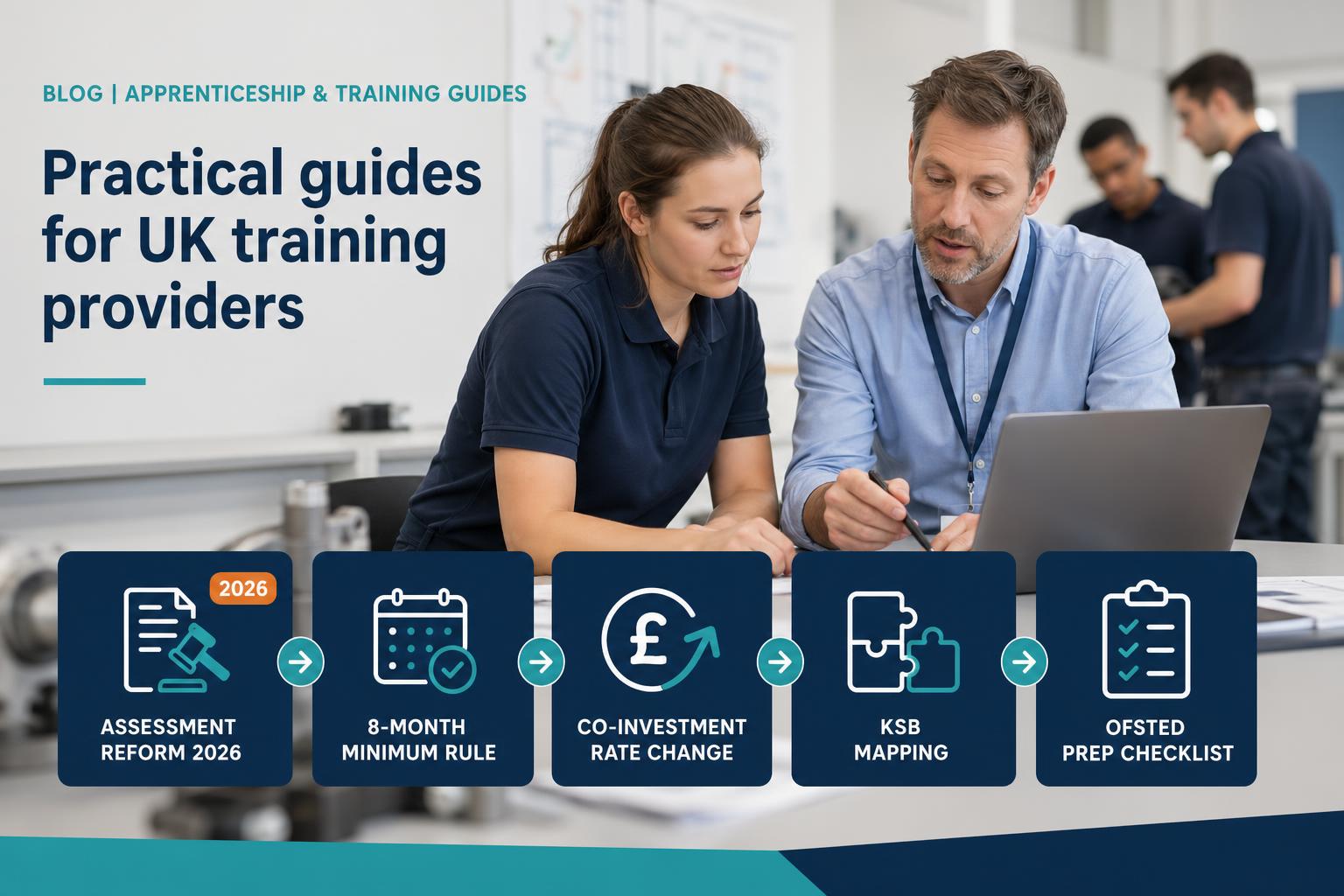
The 8-Month Apprenticeship Minimum: Final 2026/27 Rules for Providers
Final 2026/27 apprenticeship duration rules: the eight-month practical minimum, standard-specific off-the-job hours, the 187-hour prior-learning floor and earlier-start distinctions.
Apprenticeship Employer Engagement: A Complete Guide for Providers
A practical employer-engagement guide for apprenticeship providers, updated for the August 2026 funding routes, training-plan duties and three-way progress-review rules.
Apprenticeship Co-investment Rates from August 2026: 25%, 5% or Fully Funded?
From 1 August 2026, the employer contribution depends on whether the employer pays the levy, whether its account has enough funds, and the apprentice's age. This corrected guide explains the 25%, 5% and fully funded routes.
Apprenticeship Assessment Reform 2026: What Training Providers Need to Know
Skills England published final requirements for apprenticeship assessment in June 2026, but revised assessment plans take effect standard by standard. This guide explains content sampling, employer verification of behaviours, assessment-organisation oversight and the transition from current EPA plans.
AI Upskilling Your Workforce: A Step-by-Step Guide for HR and L&D Teams
AI upskilling is no longer optional for organisations that want to remain competitive, attract talent, and manage the regulatory expectations building around AI use. This guide walks through the six steps of a well-designed AI upskilling programme — from capability audit to behaviour-level measurement — with practical detail at each stage.
AI Literacy Training: How to Build a Workforce That Can Work With AI
Most organisations know their workforce needs AI skills. Far fewer know what those skills actually are, who needs them, and how to build them systematically. This guide gives L&D and HR professionals a practical framework for designing an AI literacy programme that reaches the whole workforce — not just the technical teams.
AI Change Management: How to Train Employees to Adapt to AI-Augmented Work
Most organisations focus on the technology side of AI adoption and significantly underinvest in the human side. This guide covers how to design training programmes that address the fears employees actually have, apply a structured change model, and build adoption that sticks.
Why employees don’t complete training — and what L&D teams can actually do about it
Low training completion rates are one of the most common L&D problems and one of the most misdiagnosed. The standard response — send a reminder email, make the content shorter, add gamification — treats symptoms rather than causes. This guide covers what completion rates actually measure, the five structural root causes of low completion, the benchmarks that give context to your numbers, and the fixes that address root causes rather than surface symptoms.
LXP vs LMS: the decision guide for US mid-market L&D teams
The LXP vs LMS debate is framed as a technology choice. It isn’t. It’s a question about what problem you’re actually trying to solve — and whether the problem is worth the investment to solve it. This guide explains what each system actually does, when the LXP solves something the LMS doesn’t, when you need both, and why most US mid-market teams that buy an LXP to replace their LMS end up with the same engagement problem two years later, plus a larger contract.
Youth Jobs Grant: How Employers Can Claim the £3,000 Payment in 2026
The Youth Jobs Grant launched on 30 June 2026. This guide covers employer, candidate and vacancy eligibility, approval before hiring, and the exact £1,800 and £1,200 payment triggers.
Youth employment drive 2026: policy tracker for training providers
A status-led July 2026 tracker covering the live Youth Jobs Grant, phase-one and national Jobs Guarantee, apprenticeship hiring support, foundation apprenticeships and apprenticeship units.
£2,000 Apprenticeship Hiring Payment: Non-Levy Employer Rules for 2026
The October 2026 apprenticeship hiring payment is for eligible non-levy employers, not businesses selected by an SME headcount test. Check the age, employment, PAYE and payment rules.
Jobs Guarantee 2026: what training providers need to know about the expanded scheme
Phase one of the Jobs Guarantee is live in six areas and the Great Britain national rollout is planned from November 2026. This July update explains the confirmed six-month job model, eligibility, delivery-partner role and boundary with the live Youth Jobs Grant.
Apprenticeship Units Explained: Funding, Delivery and Provider Rules for 2026
A corrected guide to approved apprenticeship units: live specifications, learner eligibility, one-to-sixteen-week delivery, funding rules and the evidence providers need.
T-Levels vs Apprenticeships: What Employers and Providers Need to Know
T-Levels and apprenticeships are both government-backed technical education pathways — but they are fundamentally different in structure, funding, employer obligation, and learner experience. This guide covers the key differences and what they mean for employers choosing a training pathway and providers considering delivering both.
Personalised Learning with AI: What Training Teams Need to Know
Personalised learning has been the ambition of the L&D profession for decades. AI is finally making it viable at scale — but “personalised learning with AI” means very different things depending on who is selling it. This guide separates genuine personalisation from adaptive veneer and explains what you actually need to deliver it.
Ofsted Monitoring Visit: What to Expect and How to Prepare
An Ofsted monitoring visit is not a full re-inspection — but it is not routine either. It is a targeted assessment of whether a provider has made sufficient progress against specific areas for improvement since their last grade. This guide explains what triggers a monitoring visit, what inspectors focus on, and how to prepare your evidence.
Maths and English Requirements in Apprenticeships: 2026/27 Rules Explained
The final 2026/27 apprenticeship English and maths rules explained: 16–18 achievement, 19+ employer opt-in, gateway evidence, prior attainment, training-plan and ILR requirements.
Level 7 Apprenticeship Funding: What the Government Cuts Mean for Providers
Since 1 January 2026, government funding for new Level 7 apprenticeship starts has normally been limited by the apprentice’s age and circumstances, not by a shortlist of standards. This guide explains the eligibility rule, protection for earlier starts, privately funded delivery, and the actions providers should take.
Green Skills Apprenticeships: Standards, Funding, and Delivery in 2026
Green skills are a national priority for the UK government — and apprenticeships are one of the primary mechanisms for building them at scale. For training providers, green skills apprenticeships represent both a significant growth opportunity and a delivery challenge. This guide covers the landscape, the standards, the funding, and what you need in place to deliver well.
Foundation Apprenticeships: 2026/27 Provider Guide
A current provider guide to England's Level 2 foundation apprenticeships: learner eligibility, live sectors, eight-month minimum, funding, employer incentives, OTJ requirements, assessment and delivery controls.
Best AI Tools for Employee Training (2026): What L&D Teams Are Actually Using
The AI tools market for employee training has exploded — and the gap between tools that save genuine time and tools that add a veneer of “AI” to unchanged workflows has never been wider. This guide covers the categories that matter, the tools L&D teams are actually using, and how to evaluate them against your real training needs.
Reducing Apprenticeship Early Leavers: A Practical Retention Guide for Training Providers
Apprenticeship withdrawal remains a persistent sector challenge and an important indicator of whether apprentices participate, progress and achieve. This guide covers why apprentices leave early, what providers can influence, and how to build retention into delivery while applying the correct start-date funding and assessment rules.
Apprenticeship Levy Transfers: The 50% Rule for Employers and Providers
A levy payer can transfer up to 50% of the relevant previous tax year's levy funds. This guide explains eligible products, above-maximum costs and the approval workflow.
AI vs Traditional Training ROI: A Data-Driven Comparison for L&D Budget Holders
The ROI case for AI-powered training is more nuanced than vendor slide decks suggest — and more compelling than sceptics assume. This guide cuts through the noise with concrete cost comparisons, a realistic ROI framework, and a 3-year business case model you can adapt for your own organisation.
How to Use AI to Create Training Content Faster (Without Sacrificing Quality)
AI content tools can reduce training course development time by 40–60% for the right content types. But “right content types” is doing a lot of work in that sentence — AI-generated content for technical, high-stakes, or legally sensitive training still needs significant human oversight. This guide covers where AI genuinely accelerates content creation and where it creates more work than it saves.
AI Tools for L&D Managers: What’s Worth It and What’s Just Hype
L&D managers are under more pressure than ever to deliver more training impact with flat or shrinking budgets. AI tools promise to help — but sorting genuine productivity gains from expensive hype is harder than it should be. This guide is written for L&D managers who want practical answers, not vendor pitches.
AI Tools in Apprenticeship Delivery: What Works, What Doesn’t, and What to Look For
AI is increasingly present in apprenticeship management software — but vendor marketing often outpaces operational reality. This guide cuts through the noise: where AI is genuinely saving tutors time, where it introduces risk, and the specific questions you need to ask before committing to an AI-powered platform.
AI-Powered Skills Gap Analysis: A Practical Guide for HR and L&D
Identifying skills gaps has always been expensive, time-consuming, and prone to bias when done manually. AI tools are changing this — making it possible to map skills across large workforces quickly and connect gaps directly to training plans. This guide explains how skills gap analysis with AI works, what it requires, and what to do with the results.
AI Onboarding Tools: How to Cut Time-to-Productivity and Personalise Day One
Poor onboarding costs more than most organisations measure. AI-powered onboarding tools are changing the equation — automating admin, personalising learning paths from day one, and using conversational AI to answer new-hire questions at 11pm without anyone from HR being on call. This guide covers where AI genuinely helps, what to evaluate, and what it cannot replace.
AI Coaching Tools for Managers: What’s Available and What Works in 2026
Manager development is one of the highest-ROI investments an organisation can make — and one of the hardest to scale. AI coaching tools are changing the economics: delivering personalised, practice-based coaching to hundreds of managers simultaneously, at a fraction of the cost of traditional coaching programmes. This guide covers what’s available, what actually works, and what AI coaching cannot replace.
OSHA training requirements 2026: the practical guide for US mid-market employers
OSHA’s General Duty Clause requires employers to provide a workplace free from recognized hazards. More specifically, dozens of OSHA standards — covering everything from hazard communication to emergency action plans — impose explicit training requirements with defined content, timing, and documentation standards. This guide covers the training requirements most relevant to office and general industry mid-market employers, the documentation OSHA inspectors look for, and how to build a compliance program that holds up to scrutiny.
How to build a manager development program that actually changes behavior
Most organizations have a manager development program. Most of those programs fail to change behavior in any measurable way. Research consistently shows that less than 25% of managers apply what they learned in management training three months after completing it. This guide covers why the standard approach fails, what the skill domains are that actually move team performance, how to structure a program that produces behavioral change rather than just knowledge transfer, and how to measure whether the program is working.
How to conduct a skills gap analysis: the step-by-step guide for US L&D teams
A skills gap analysis is the process of comparing the skills your organization currently has with the skills it needs to achieve its business objectives — and identifying where the difference is large enough to act on. This guide covers the full process: defining required capabilities, assessing current state, prioritizing gaps by business impact, and translating analysis into a training plan your CHRO and CFO will both support.
How to calculate training ROI: the step-by-step model for US L&D teams
Training ROI is not complicated in theory. It is the net financial benefit of a training program divided by its cost, expressed as a percentage. In practice, L&D teams fail at two specific steps: isolating the training’s contribution from other factors, and converting outcome data into dollars that finance will accept. This guide walks through the Phillips ROI Methodology step by step and shows you where most calculations go wrong.
State harassment prevention training requirements: the 2026 guide for mid-market HR
Seven US states now mandate sexual harassment prevention training, and the requirements differ significantly on duration, coverage thresholds, frequency, and content. This guide covers each state’s current requirements, the practical compliance gaps HR teams most often miss, and how to build a single training architecture that satisfies all of them without maintaining seven separate programs.
Degree apprenticeships: a complete guide for employers and training providers
Degree apprenticeships are the fastest-growing segment of the apprenticeship market — but they come with a different set of delivery requirements, compliance obligations, and stakeholder relationships than standard apprenticeships. This guide covers how they work, what employers need to know, how the HEI relationship works, and what the gateway process looks like at degree level.
Closing the skills gap with AI-enabled training: a strategy guide for US mid-market L&D leaders
The skills gap in US mid-market companies is no longer primarily a hiring problem — it's a development problem. Most organizations can't hire their way out of it fast enough or cheaply enough, and traditional training programs close gaps too slowly to keep pace with role evolution. AI-enabled training changes the economics. This guide explains how to identify which skills gaps matter most, how to close them faster with AI-assisted workflows, and how to demonstrate the impact to the business.
How to reduce manager admin time with AI: a practical guide for US L&D and operations leaders
Most US managers spend 12–18 hours per week on work that doesn't require their judgment — status updates, report prep, meeting summaries, planning documents, and follow-up tracking. AI can reduce this significantly. This guide explains which workflows to target first, how to measure the impact, and how to build a 30-day implementation plan that produces an executive-ready ROI readout.
How to prove L&D ROI to the CFO: the metrics, the model, and the presentation
L&D budgets are under pressure at every US mid-market company. CFOs want to see returns, not activity reports. This guide gives you the measurement framework, the ROI calculation model, and the presentation structure to build a finance-ready case for your training investment — one that finance can approve, not just acknowledge.
Why AI tools don't produce productivity gains — and the five fixes that actually work
Most US companies now have AI tools available to their managers. Most are not seeing measurable productivity gains. This is not because AI doesn't work — it's because tool availability is not the same as workflow change. This guide explains the five root causes of the productivity gap and the specific interventions that close it.
Why AI adoption drops off after week 2 — and the five fixes that prevent it
Most AI enablement programs follow the same trajectory: strong initial interest, a productive week one, declining usage through week two, and a return to old habits by week three. This pattern is not random — it has five specific structural causes, each with a specific fix. This guide explains the drop-off mechanism and what to build into your program design to prevent it.
Recognition of prior learning in apprenticeships: a provider guide
How RPL works in apprenticeships — what counts as prior learning, how it affects programme duration and OTJ hours, how to document it, and common compliance mistakes.
Ofsted deep-dive evidence update tracker (2026)
Use this running tracker to monitor evidence quality themes and maintain inspection-readiness discipline across learner files, progress reviews, and IQA controls.
ILR outcome and withdrawal codes: a reference guide for training providers
All ILR completion status, outcome, and withdrawal reason codes explained for UK apprenticeship providers — when to use each code and common errors to avoid.
Growth and Skills Levy policy tracker (2026)
A July 2026 tracker for apprenticeship providers and employers: what the Growth and Skills Levy funds now, what changes on 1 August and 1 October, and which claimed flexibilities are not supported by the current rules.
Gateway delay benchmark report (2026): top 10 causes and prevention controls
This report summarises recurring gateway delay patterns seen across provider operations and the practical controls teams use to reduce delay risk before final review windows.
Functional skills requirements for apprenticeships: a compliance guide
Current 2026/27 English and maths rules for apprenticeships: the age-at-start split, 19+ employer opt-in, gateway evidence, prior qualifications and ILR tracking.
ESFA / ILR reporting update tracker (2026)
Use this page as a monthly checkpoint for reporting teams. It focuses on practical reporting controls, validation routines, and operational actions to maintain confidence in compliance outputs.
EPA Grading: How Apprenticeship Grades Are Determined and How Providers Can Support Better Outcomes
EPA remains the correct term for apprentices following an existing end-point assessment plan. Revised plans introduced through the 2026 assessment reforms use apprenticeship assessment, assessment organisation and gateway to completion. This guide explains how grading works during the transition, why the exact standard version and assessment plan matter, and how providers can support strong outcomes without teaching to assumptions that may not apply.
Employer Levy Account Management: August 2026 Top-Up, Expiry and Funding Rules
Manage the August 2026 transition correctly: no top-up and a 12-month expiry for new funds, while older account funds retain their existing treatment.
Apprenticeship Breaks in Learning: 2026/27 Compliance Guide
Current break-in-learning rules for apprenticeships starting in 2026/27: when a break is required, ILR timing, return-to-learning records, off-the-job hours, employer changes and funding pauses.
Apprenticeship Subcontracting Rules: What Training Providers Need to Know
The 2026/27 apprenticeship funding rules require providers to directly deliver substantive training, justify subcontracting on educational grounds, agree it with employers and keep control of quality and data. This guide explains APAR eligibility, the £100,000 de-minimis and audit thresholds, the 25% exemption threshold, fee transparency and reporting deadlines.
How to start an apprenticeship: step-by-step guide for training providers
How to start an apprenticeship under the final 2026/27 rules: eligibility, initial assessment, the training plan, apprenticeship agreement, ILR, employer approval and first review.
Apprenticeship Progress Reviews: A Practical Guide for Training Providers
Progress reviews connect the apprentice, employer and provider around the agreed training plan. This July 2026 guide explains the current three-calendar-month rule, the evidenced alternative timetable, employer attendance, off-the-job training, English and maths, and the evidence Ofsted may consider.
OneFile, Aptem & Smart Assessor Alternatives: Choosing the Right Apprenticeship Platform in 2026
The UK apprenticeship software market has been dominated by the same platforms for a decade. OneFile, Aptem, and Smart Assessor were built in a different era — before AI, before the Growth and Skills Levy, and before providers routinely managed multiple training types simultaneously. This guide is for providers who are evaluating alternatives: what's actually different now, how to compare platforms fairly, and what migration really involves.
Apprenticeship Management Software: A Complete Buyer's Guide for UK Training Providers (2026)
Choosing apprenticeship management software is one of the most consequential operational decisions a training provider makes. Get it right and your tutors spend less time on admin, your learners are better prepared for EPA, and your Ofsted readiness improves. Get it wrong and you're managing three disconnected tools, running manual exports, and hoping nothing falls through the gaps. This guide covers everything you need to evaluate, shortlist, and choose confidently.
Skills Bootcamps: The Complete Provider Guide (2026)
A current guide to the separately commissioned Skills Bootcamp offer in England: 2026/27 local funding, employer contributions, outcome evidence and the route for prospective providers.
Off-the-Job Training Hours in 2026/27: What Counts and the New Minimums
For new apprenticeship starts, providers must use the minimum OTJ hours published for the standard—not a blanket 20% calculation. Here is what counts, what does not, and what must be evidenced.
The Complete Guide to KSB Mapping for Apprenticeship Providers
KSB mapping is the foundation of every successful apprenticeship programme — yet it's also one of the most common sources of EPA delays, Ofsted findings, and provider risk. This guide covers what KSBs are, how to map them correctly, and how AI is changing the process for good.
The Growth and Skills Levy: What Training Providers Need to Know in 2026
A current guide to the approved Growth and Skills Levy products, August 2026 account changes, co-investment rates, foundation apprenticeship eligibility and apprenticeship unit rules.
Apprenticeship Training Plan (Formerly Commitment Statement): 2026 Provider Guide
The apprenticeship commitment statement is now called the training plan. This start-date-aware guide explains what the 2026/27 funding rules require, who signs, when to update it and the audit checks providers should run.
Apprenticeship platform strategy briefing (with transcript)
A practical provider briefing on platform selection, migration sequencing, reporting confidence, and gateway-risk controls. Use this page as a reference document for leadership and delivery planning discussions.